
About Chadds Ford
As a lifelong resident of the Brandywine Valley, I have always been inspired by the bucolic region of Southeastern Pennsylvania. The village of Chadds Ford really has everything I could ever ask for in a home – a variety of rustic landscapes, four magnificent seasons, a rich history, and a tight-knit community of welcoming, inclusive people. I would like to share a bit about the history, culture, and scenery of Chadds Ford that have heavily influenced my jewelry creation and design.
About Chadds Ford
The village of Chadds Ford is a lovely unincorporated community nestled along the Brandywine River in the heart of Southeastern Pennsylvania. While it doesn't technically have any kind of municipal status, Chadds Ford's charming collection of historic buildings, restaurants, museums, and shops make it feel like a village to me -- so that's what I like to call it! In recent years, the boundaries of what people tend to think of as "Chadds Ford" have expanded considerably. In 1996, Birmingham Township, Delaware County, which encompasses not only the village of Chadds Ford but also a substantial amount of additional ground, adopted a new name: Chadds Ford Township. And, just a few years ago, Chadds Ford became a census-designated place, with boundaries including not only Chadds Ford Township in Delaware County, but also Birmingham Township in Chester County. But while the borders of Chadds Ford may have changed and evolved over the years, the village itself has always echoed the beauty and simplicity of its early American roots.
The John Chads House
The village of Chadds Ford is named after John Chads, a property owner and ferry operator, who lived in the village in the early eighteenth century. While Chads' original family name was Chadsey, the shortened version of this name was spelled as both Chads and Chadds. Historians argue that Chads is the correct spelling, but the village bears Chadds nevertheless. The John Chads House, which stands near the center of town, was built for John and his wife Elizabeth by John Wyeth Jr. in 1712 on land that was originally owned by William Penn, the founding proprietor of Pennsylvania. The property was initially the site of his family's grist mill and millrace, but Chads ultimately made his living running a ford and ferry crossing on the Brandywine. During the Revolutionary War, the John Chads House became a focal point during the Battle of Brandywine -- General Washington's men used the fence for firewood and took advantage of his ferry crossing, which had been maintained by John's wife, Elizabeth, after his death in 1760. Restored several decades ago, the John Chads House remains a fixture of modern Chadds Ford.
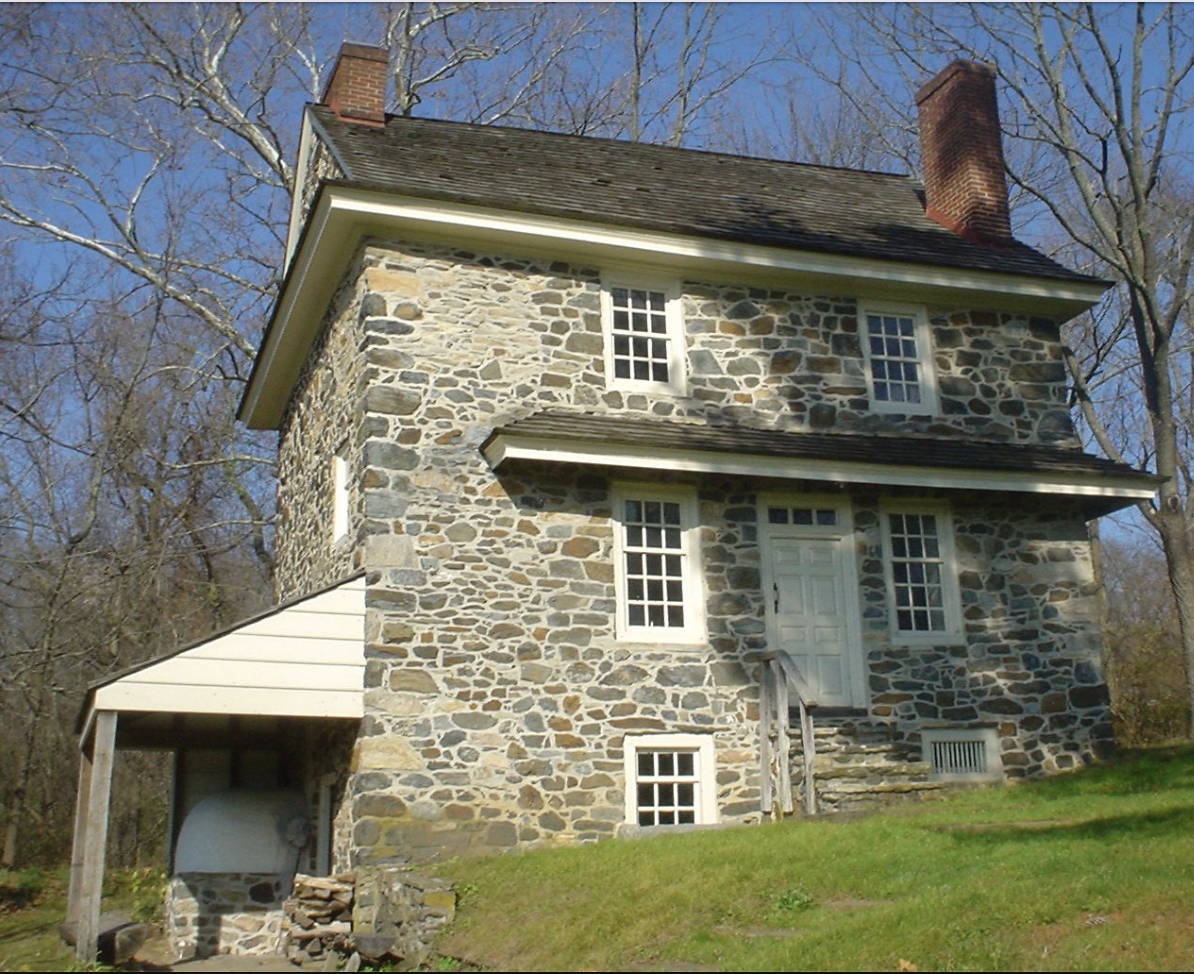
The John Chads House, located in the heart of Chadds Ford.
The WYeth Family
The Wyeth family, all descendants of famous illustrator N.C. Wyeth, have made an indelible impact on Chadds Ford. N.C., one of America’s great painters and illustrators, was originally from Needham, Massachusetts, but moved to Wilmington, Delaware in 1902 to enroll in the Howard Pyle School of Art. Over the course of his life, he created over 3,000 paintings and developed illustrations for 112 books, including the famous Treasure Island. In 1908, he and his wife Carolyn relocated to nearby Chadds Ford permanently, where they raised their five children: Andrew, Henriette, Carolyn, Ann, and Nathaniel.
While all of N.C.'s children had special talents, Andrew and his son, Jamie, went on to have prolific careers in painting and illustration just like N.C. Their work, along with the works of several other Wyeth friends and family members, is on display in the Brandywine Museum of Art, located in the heart of Chadds Ford. Andrew followed in his father's footsteps as a realist painter, often taking inspiration from his Chadds Ford roots. He appreciated the works of Henry David Thoreau and Robert Frost, both of which heavily influenced his own contributions. Andrew was especially fond of fall and winter, because he felt that you could better feel the structure of the landscape during those seasons, with the added mystery of something waiting just beneath -- a whole story destined to show, just not quite yet. Several of Andrew Wyeth's paintings hang in my home, where they serve as a source of inspiration for my Landscapes Collection.
Andrew's son Jamie, a realist painter who follows the Brandywine School of Art like just like his father and grandfather, grew up on his parents' farm in Chadds Ford with his brother Nicholas. As a boy, Jamie worked with his aunt, Carolyn Wyeth, learning the ins and outs of oil painting. His subjects span people, animals, and landscapes, all of which echo the lessons he learned from his illustrious family members. Jamie's painting entitled "Portrait of Pig" is one of my very favorite pieces of art!
Designs Inspired by Chadds Ford
ThE Brandywine River
The flowing waters of the Brandywine River are central to life here in Chadds Ford. In fact, this famous tributary (which is actually a creek) has been sustaining civilization and culture here in the Brandywine Valley for hundreds of years. Originating in the scenic area of Welsh Mountain, the Brandywine weaves and winds its way for 20 miles before opening up into the Christina River in Delaware. Ever since I was a teenager, I have loved strolling along its sandy, mossy banks, enjoying the placid yet powerful beauty of its waters -- the Brandywine is a major inspiration for much of my creative work! Here is a bit more about the history of the river and its impact on our region's development:
History of the Brandywine River: Fast Facts
The Lenape tribe used to refer to the Brandywine River as "Wawaset," "Sittacunck," and "Tankopanican."
Legend has it that the River got its name from a Dutch ship that wrecked at the mouth of the river while carrying Brandywine, a much-loved Dutch spirit. According to most historians, however, it was more likely named after local mill owner Andreas Brainwende (Brantwyn).
In the 1600s, the Brandywine River was a critical resource for the settlers of the New Sweden Colony.
On September 11, 1777, the river played a central role in the Battle of Brandywine.
During the Industrial Revolution, the river was the source of power to both grist mills and the famous du Pont gunpowder mills located just over the line in Delaware.
The Battle of Brandywine
Taking place on the banks of the river, the Battle of the Brandywine was one of the longest battles in the Revolutionary War. Lasting almost 11 hours, General George Washington’s American Continental Army was ultimately pushed back by General Sir William Howe and the British Army. Howe’s British Army descended upon Chadds Ford by way of Maryland -- while diversionary fighting with American forces unfolded on the banks of the River near the village, the bulk of Howe's army crossed the Brandywine to surprise General Washington and the right flank of his troops. British forces and their allies were able to defeat the American Army, ultimately allowing for the capture of Philadelphia two weeks after the Battle of the Brandywine. Throughout Chadds Ford and the surrounding area, important locations within the battle such as Birmingham Hill, Sandy Hollow, Dilworthtown, and the Battlefield itself remain as well-preserved landmarks and parks.
Smith Bridge
When I close my eyes and think of my favorite local landmarks, Smith Bridge is always one of the first images that comes to mind. This iconic covered bridge was originally constructed in 1839 near the Pennsylvania-Delaware line, and it straddles the flowing waters of the Brandywine. It is one of very few remaining covered bridges in Delaware; although it had to be refurbished after a fire in 1961 and again in 2002, it still bears a traditional, historic appearance with exposed wooden beams and red paint. When my children were small, they always loved the reverberating rumbles our car tires made as they rolled over the wooden planks of the bridge. I even have a framed print of this bridge in our living room, where the bridge sits front and center, covered in snow, exhibiting the unique and established beauty of our region.
du Pont Estates
If you live locally or have an interest in the Industrial Revolution, then the du Pont family name is likely something you know by heart. The du Ponts arrived in the United States from France in 1800, and Éleuthère Irénée du Pont established a gunpowder mill in Wilmington, Delaware on the banks of the Brandywine River in 1802. As the du Pont family’s influence in the region grew, so did their presence in architecture, philanthropy, and commerce. Many of their estates and conservatories have been well-preserved: Winterthur, Longwood Gardens, Nemours, Hagley, and Mt. Cuba are just a handful of Brandywine Valley landmarks that draw thousands of visitors every year and provide sanctuary for plants and wildlife. The du Pont family estates feature expansive lawns, picturesque gardens, beautiful meadows, and verdant woodlands, and I’ve developed some of my best ideas for jewelry while walking on their grounds!
Places to Visit
Chadds Ford is a wonderful place to visit and to live due to its beautiful scenery and close location to Philadelphia. If you happen to be in the area, here are a few places in the region you won't want to miss:
Capture the magic of Chadds Ford.
Shop our premier collection of keepsake jewelry today.